During the war, the War Department issued a series of 9 booklets titled "Combat Lessons Rank and File in Combat. What they're doing, How they do it"
These pamphlets were intended for both officers and enlisted men to share valuable insights that
had been learned in combat to date. These publications are not dated, but the scanned documents
include a variety of hand written or rubber stamped notes that do have dates on them. One can
assume that the documents were printed and distributed at the time of, or prior to the dates added
to the printed copies. In the list, the date listed is the earliest date notation that is seen
in the document scan. It seems that the first document was published in early 1944, with the
remaining issued in rapid succession through 1944 and 1945. The introduction of issue 1 states: "The purpose of 'Combat Lessons' is to give to our officers and enlisted men the benefit of the battle experiences of others. To be of maximum benefit these lessons must be disseminated without delay.'
The documents contain quotes from US personnel, and have specific advice for combat in different
environments such as Jungle, mountain, woodland, cities, winter, and specific advice for fighting German vs Japanese forces.
Because the war in Europe ended earlier than in the Pacific, issues 7,8,9 focus primarily on the Pacific theater.
The documents were originally classified information, with a variety of classification and declassification
stamps on theses copies. In 1986, the entire set was declared unclassified by executive order 10501.
WW2 Combat Lessons, Issue 1 May 1944 rubber stamp mark
As the earliest of these publications, it covers a wide variety of topics, with it's
European lessons coming from Italy. Topics included infantry and tank tactics, Italy and the
South Pacific. Patrolling, Field Artillery, and a section on each the Germans and Japanese,
titled "Hints on the Heinie", and "Notes on the Nips". Interestingly, the series
seems to have little information about desert warfare, presumably because the
battle for North Africa had been decided before the publication of these documents, and additional
desert fighting was thought to be unlikely.
WW2 Combat Lessons, Issue 2 May 1944 rubber stamp mark.
European experience continues with combat in Italy including mountain warfare, wooded terrain, and combat in towns.
Leadership, intelligence, training, transportation, tank operations, and air support are all covered.
WW2 Combat Lessons, Issue 3 July 3, 1944 stamped
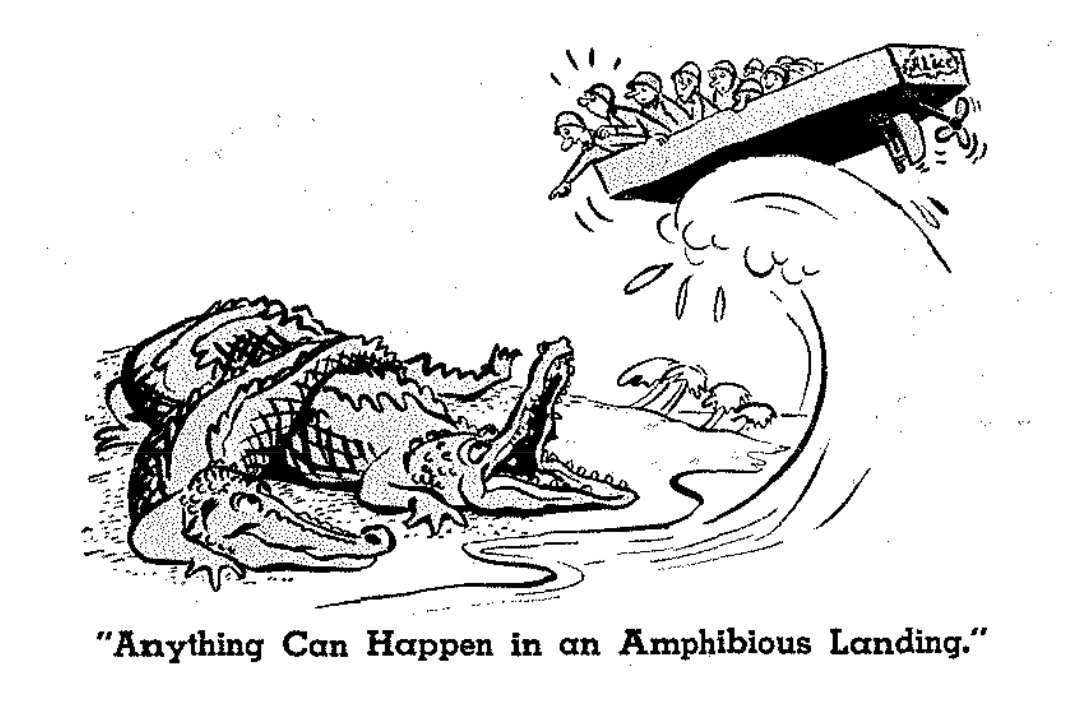
As with most of these documents, the first section is on leadership. With sections on river crossings,
mountain operations, and amphibious landings. Amphibious landing experience is presented from both Italy
and the Pacific. Both large and small lessons are included, from principles of leadership and command
to hygine and avoiding trench foot.
WW2 Combat Lessons, Issue 4 Earliest date found on the scan
is September 1945 when it was first declared unclassified.
This document is the first to contain lessons from the Normandy invastion with specific lessons about
hedgerows and other features of fighting in France. The amphibious operations sections covers Normandy,
and the Pacific islands of Los Negros and Kwajalein. The prevention and treatment of malaria is covered.
WW2 Combat Lessons, Issue 5 No useful date markings, but the presense of information from Leyte Gulf means the document was post
October 1944 at it's earliest. An interesting observation was that "The Boche does not like night fighting.
We have caught him off guard several times by launching our attack 30 minutes or so before dawn" Another
note is that attacks shortly before dark are also effective. The document also contains information from
combat in Burma.
Several accounts of exploits by Piper Cub aircraft are presented. One instance is a Piper Cub
successfully strafing and bombing fleeing Japanese troops with a submachine gun and grenades.
Another is a battle between Piper Cub artillery spotter planes and a German Panzer VI Tiger. "With the tank firing its antiaircraft weapons and the cub adjusting artillery fire, the battle lasted 2 1/2 hours.
The tank, being a mobile target, kept changing position, making an adjustment very difficult. Finally
with the aid of another cub, the fight came to an end. One cub placed a battery volley of artillery fire behind
the tank while the other cub adjusted a battery just in front. The tank was on a road and could move neither to
its right nor its left because of very high hedgerows. Then the two cubs shifted their battery fires as though
closing a telescope and knocked out the tank"
WW2 Combat Lessons, Issue 6 July 2, 1945 stamped
Among the usual subjects of leadership, patroling, and amphibious warfare, practical "Popular Mechanics, Battle-Front Style"
tips include making protective shoes for war dogs, building water lines out of bamboo, portable showers, and
maintenance of stoves and lanterns.
From a section titled Get Wise to their Wiles: "Enemy troops have used firecrackers for diversionary purposes" "When outnumbered, the Japanese appear to be willing to have our troops overrun their positions; evidently
they believe that they can inflict maximum damage by attack from within our lines"
WW2 Combat Lessons, Issue 7 Note added "Changed from RESTRICTED to CLEAR 29, Sept 45."
The opening of this issue states: "Our armies in Europe have won their victory. Veterans of the campaigns in North Africa and Europe are now joining forces
with the veterans of the Pacific for the final assault against Japan. They are coming to grips with a foe quite different
form the German Soldier, different as an indvidual fighting man, and different in the tactics employed.
Even the most experienced soldier of the European battlefields will have much to learn."
The leadership section extensively covers proper orientation and integration of replacement troops, and the dangers of
overly alarming replacements about the dangers of their assignment. Experience has shown me that enlisted men who come in as replacements are subjected to morale-breaking tales. I
have tried to get my old men to give the new replacement a break by being careful not to exaggerate their battle experiences
or in any way distort the picture of front-line existence. Give the new men a common-sense introduction tot he combat zone
and there will be fewer men going on sick call before an attack."
WW2 Combat Lessons, Issue 8 Contains an stamp stating that the document was revised to unclassified on 26, Sept 45.
In the leadership section, it talks of men becoming complacient and how to combat that.
In an advance past camoflaged "spider holes": "They moved on, 25, 30, 40 yards. There was still no enemy fire. The men searched the first few lines of
holes diligently, ripping the fronds off with their bayonets. They found nothing. Lieutenant Blue
noticed that they had already begun to ease up, hitting a hole here and skipping a hole there. They went on for another
25 yards. The man ahead of Blue stepped across a frond patch and kept moving. Blue yelled: 'Godammit, what are you doing, stepping across a hole
you're supposed to search? There may be a Jap in there.' And a Jap gets a chance, A jap rifle lay across the hole, from underneath,
a hand reached up for it before Blue could close the distance. Blue saw the hand; saw, also that five of his men were behind it and in the line of fire.
He took the chance and fired at the hand. The bullet split the hand at the knuckles. The Jap had started to rise, but Blue's rifle was
so close that the blast knocked him back again and the helmet flew from his head. 'Start looking into every hole or we'll all be killed! Blue shouted to his men."
WW2 Combat Lessons, Issue 9 While no date stamps are noted, this final document was produced near the end of the war, as it mentions the
coming assault on the Japanese home islands, and also covers the battle of Okinawa.
A cartoon for the section about Japanese infiltration methods shows two GIs sitting on a log at dusk eating
dinner, with a grinning Japanese soldier enjoying GI rations sitting between them. In a passage about Banzai attacks: It has been found by all units in the XIVth Corps that the most efficient and least costly way to kill Japs is to
let them attack at night. The 'Banzai attack is the ultimate in Jap-extermination efficiency. The success of a
unit here is measured in terms of how many Japs it has killed, so rather than promote night attacks on our part,
it seems better to set up a good perimeter defense and then get the Jap to attack" A large section covers infantry and tank teamwork. Others include information about medics, and maintaining
communications.